
Garage doors might look simple from the outside but their springs do some serious heavy lifting. Most homes rely on springs that are designed to last around 10,000 open-close cycles or about 7 to 10 years. Surprising, right? The real shock comes when you realize a faulty spring can quickly turn convenience into chaos by bringing your daily routine to a halt in seconds.
Table of Contents
- What Are Garage Door Springs And Their Types?
- Why Are Garage Door Springs Essential For Functionality?
- How Garage Door Springs Operate: The Science Behind It
- Exploring The Mechanics Of Tension And Compression
- Signs Of Wear And The Importance Of Maintenance
Quick Summary
| Takeaway | Explanation |
|---|---|
| Garage door springs counterbalance heavy doors | They enable smooth opening and closing by supporting the door’s weight effectively. |
| Two main types: Torsion and Extension | Torsion springs provide consistent support; extension springs are cheaper but need more maintenance. |
| Regular maintenance prevents spring failure | Look for signs like rust or jerky movement to avoid unexpected breakdowns and ensure safety. |
| Proper spring calibration is essential | Incorrect tension can lead to unbalanced movement, increasing mechanical wear and safety risks. |
| Springs convert potential energy into motion | They store energy during door closure and assist in lifting during opening, reducing motor strain. |
What Are Garage Door Springs and Their Types?
Garage door springs are critical mechanical components responsible for counterbalancing the massive weight of your garage door, enabling smooth and controlled opening and closing movements. These powerful yet delicate mechanisms store and release mechanical energy to assist your garage door’s operation, making them essential to the entire door system.
Understanding Garage Door Spring Mechanics
Garage door springs work through a fundamental principle of potential energy storage. When your garage door closes, these springs compress and accumulate tension, storing potential energy. When you initiate the opening sequence, this stored energy helps lift the heavy door panel, reducing the workload on your garage door opener motor.
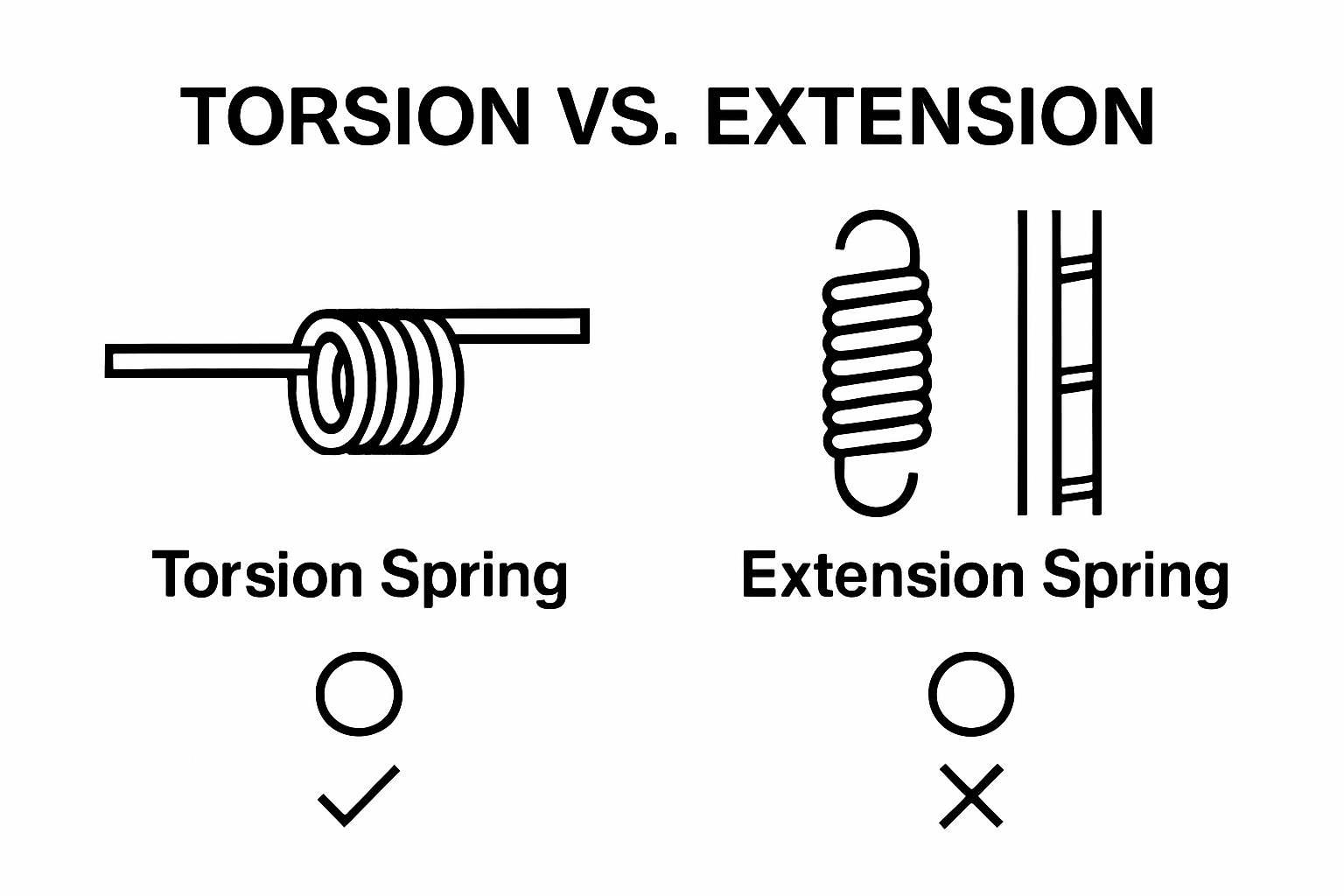
Two primary types of garage door springs exist, each with unique characteristics and application scenarios:
-
Torsion Springs: Mounted horizontally above the garage door opening, these springs twist and store energy by rotating around a metal shaft. They provide more consistent and balanced lifting power.
-
Extension Springs: Positioned alongside the door tracks, these springs stretch and contract during door movement. They are typically less expensive but may require more frequent maintenance.
Key Characteristics of Garage Door Springs
The performance of garage door springs depends on several critical factors. Our expert technicians at Summit Garage Doors understand that springs must be precisely calibrated to match your specific door’s weight and dimensions. Incorrect spring tension can lead to unbalanced door movement, increased wear on mechanical components, and potential safety risks.
Most residential garage doors utilize springs rated for approximately 10,000 cycles, which translates to roughly 7-10 years of typical use. However, factors like frequency of operation, climate conditions, and maintenance practices can significantly impact their longevity.
Understanding how garage door springs work is crucial for homeowners. These seemingly simple components play a complex role in ensuring your garage door operates safely, efficiently, and with minimal strain on other mechanical parts.
Here is a comparison table summarizing the key differences between torsion and extension garage door springs to help homeowners understand how these options differ in terms of function, cost, and maintenance.
| Type of Spring | Mounting Location | Lifting Power & Consistency | Cost | Maintenance Frequency |
|---|---|---|---|---|
| Torsion Spring | Above the door opening | More consistent and balanced | Higher | Lower |
| Extension Spring | Alongside the door tracks | Less consistent, more variance | Lower | Higher |
Why Are Garage Door Springs Essential for Functionality?
Garage door springs are far more than simple mechanical components they are the critical support system that enables smooth and safe door operation. Without these precision-engineered mechanisms, homeowners would face significant challenges in managing their garage doors daily functionality.
The Weight Distribution Challenge
A typical residential garage door weighs between 150 to 250 pounds. The garage door spring system is responsible for counterbalancing this substantial weight, creating a mechanism where the door appears almost weightless during manual or automatic operation. By storing and releasing mechanical energy, springs reduce the strain on motors and human effort, making door movement effortless and controlled.
Critical Weight Management Functions:
- Counterbalancing the entire door weight
- Reducing motor strain during opening and closing
- Enabling smooth and controlled movement
- Preventing sudden door drops or uncontrolled movements
Safety and Mechanical Precision
Understanding complex garage door system components reveals how springs act as a crucial safety mechanism. When properly calibrated, they prevent rapid, uncontrolled door movements that could cause serious injury or property damage. The springs absorb and distribute kinetic energy, ensuring that your garage door opens and closes with predictable, manageable force.
According to research from engineering safety studies, improper spring tension can lead to significant mechanical risks. A spring that is too weak will struggle to lift the door, while an overly tight spring can cause sudden, dangerous movements that might damage the door mechanism or pose safety threats to users.
The intricate balance provided by garage door springs transforms what could be a cumbersome, potentially dangerous piece of equipment into a reliable, user-friendly home feature. Their role extends beyond mere mechanical function they are essential guardians of safety and operational efficiency in your garage door system.
How Garage Door Springs Operate: The Science Behind It
The operational mechanics of garage door springs represent a fascinating application of fundamental physics principles, transforming potential energy into kinetic movement through precision engineering. These sophisticated mechanical systems convert stored tension into controlled, smooth door movement through intricate design and carefully calculated mechanical properties.
Potential Energy Conversion Mechanics
At the core of garage door spring functionality lies the principle of potential energy storage and release. When a garage door closes, the springs compress or stretch, accumulating mechanical tension. This stored energy creates a counterbalance mechanism that offsets the door’s substantial weight, enabling effortless lifting and lowering.
Key Energy Transformation Principles:
- Converting stored mechanical tension into kinetic movement
- Reducing required motor power through energy redistribution
- Creating a balanced weight compensation system
- Minimizing mechanical stress on door components
Precision Engineering and Force Calculations
Our comprehensive guide to garage door system components highlights the mathematical precision required in spring design. Engineers calculate exact spring tension based on door weight, size, and expected usage cycles. These calculations involve complex formulas that determine:
- Spring Rate: How much force is required to compress or extend the spring
- Cycle Life: Number of reliable open-close movements before potential failure
- Material Stress Tolerance: Maximum tension the spring can withstand
According to engineering research on mechanical systems, the relationship between spring tension, door weight, and operational efficiency follows strict mathematical principles. A perfectly calibrated spring system ensures that minimal motor effort is required to move the door, significantly reducing mechanical wear and extending the overall system lifespan.
The science behind garage door springs transforms what appears to be a simple mechanical movement into an elegant demonstration of energy conversion and precision engineering. By understanding these principles, homeowners can appreciate the complex mechanisms that make their garage doors function smoothly and safely.
Exploring the Mechanics of Tension and Compression
Garage door springs operate through two fundamental mechanical principles: tension and compression. These opposing yet complementary forces are the cornerstone of how garage door springs transform potential energy into functional movement, creating a sophisticated system that appears deceptively simple.
Understanding Tension and Compression Forces
Tension and compression represent two critical mechanical states that enable garage door springs to function effectively. Tension occurs when a spring is stretched, storing potential energy by pulling apart its molecular structure. Compression, conversely, happens when a spring is pushed together, storing energy through molecular compression.
Key Characteristics of Mechanical Forces:
- Tension creates energy through molecular extension
- Compression stores energy through molecular condensation
- Both forces work to balance and counteract door weight
- Energy transfer occurs seamlessly between these states
Material Science and Spring Performance
Our comprehensive exploration of garage door system components reveals that spring performance depends critically on material properties. Different metals and alloys respond uniquely to tension and compression, with factors like molecular structure, heat treatment, and manufacturing precision determining overall spring durability.
According to engineering research on mechanical systems, the molecular alignment of spring materials directly influences their ability to store and release energy consistently. Torsion springs, which rotate around a central axis, and extension springs, which stretch linearly, demonstrate how these principles manifest in different geometric configurations.
The interplay between tension and compression transforms garage door springs from simple metal components into precision instruments of mechanical engineering. By understanding these fundamental forces, homeowners gain insight into the remarkable science that makes their garage doors operate smoothly and efficiently.
Signs of Wear and the Importance of Maintenance
Garage door springs are precision mechanical components that endure significant stress during their operational lifecycle. Regular maintenance and early detection of wear are crucial to preventing unexpected failures and ensuring the safety and longevity of your garage door system.
Identifying Potential Spring Deterioration
Homeowners should remain vigilant for subtle indicators of spring wear. Visual and auditory signals can provide early warnings about potential spring degradation. These signs include unusual sounds during door operation, visible gaps or asymmetry in spring coils, and changes in door movement smoothness.
Critical Warning Signs of Spring Wear:
- Visible rust or corrosion on spring surfaces
- Uneven or jerky door movement during opening and closing
- Loud grinding or squeaking noises during operation
- Noticeable gaps or separation in spring coils
- Door feeling heavier or more difficult to lift manually
Proactive Maintenance Strategies
Our comprehensive garage door maintenance guide emphasizes the importance of regular professional inspections. Springs operate under extreme tension and require specialized knowledge for proper assessment and maintenance.
According to international door maintenance standards, homeowners should schedule professional inspections at least annually. These inspections help identify potential issues before they escalate into more significant mechanical problems that could compromise door functionality and safety.
Understanding and responding to signs of spring wear is not just about maintaining mechanical equipment it is about ensuring the safety and reliability of a critical home access point.
The following table organizes the common warning signs of garage door spring wear, enabling homeowners to quickly identify problems and determine when professional attention may be needed.
| Warning Sign | Description |
|---|---|
| Visible rust or corrosion | Discoloration or flaking on spring surface |
| Uneven or jerky door movement | Door opens/closes with hesitation or not smoothly |
| Loud grinding or squeaking noises | Unusual sounds during operation |
| Noticeable gaps or separation in spring coils | Visible spaces between coils that were not present before |
| Door feels heavier or difficult to lift manually | Increased effort required to open or close the door |

Ready to Solve Your Garage Door Spring Problems?
If you have noticed your garage door moving unevenly or struggling to open and close, the mechanics and safety issues discussed in this article may sound all too familiar. Worn springs, improper tension, and a lack of maintenance can lead to bigger headaches if not addressed promptly. Summit Garage Doors understands how crucial properly functioning springs are for your security and peace of mind. We know the unique Seattle climate and its impact on spring performance, and our local technicians are experts at diagnosing and repairing these exact issues for both homeowners and businesses.

Take action before a small spring issue becomes a costly emergency. Contact Summit Garage Doors today for professional assessment, expert repairs, or a tailored replacement plan that keeps your garage door operating safely. Protect your home and simplify your routine by trusting our experienced team with your garage door needs right now. Start with a visit to our main site for more solutions and to schedule an appointment today.
Frequently Asked Questions
What are the main functions of garage door springs?
Garage door springs counterbalance the weight of the door, allowing for smooth opening and closing. They store and release energy to ease the effort required to move the door, ensuring efficient operation.
What are the different types of garage door springs, and how do they work?
The two main types of garage door springs are torsion springs, which are mounted above the door and twist to store energy, and extension springs, which stretch along the sides of the door. Torsion springs provide a more balanced lift, while extension springs are typically easier to install but may require more maintenance.
How can I tell if my garage door springs are worn out?
Signs of worn-out garage door springs include visible rust or corrosion, uneven or jerky door movement, loud grinding noises, and noticeable gaps in the spring coils. If your door feels heavier than usual, it may also indicate spring issues.
What maintenance is required for garage door springs?
Regular maintenance for garage door springs involves professional inspections at least once a year. Homeowners should also look out for signs of wear and perform routine lubrications to reduce friction and maintain smooth operation.

