
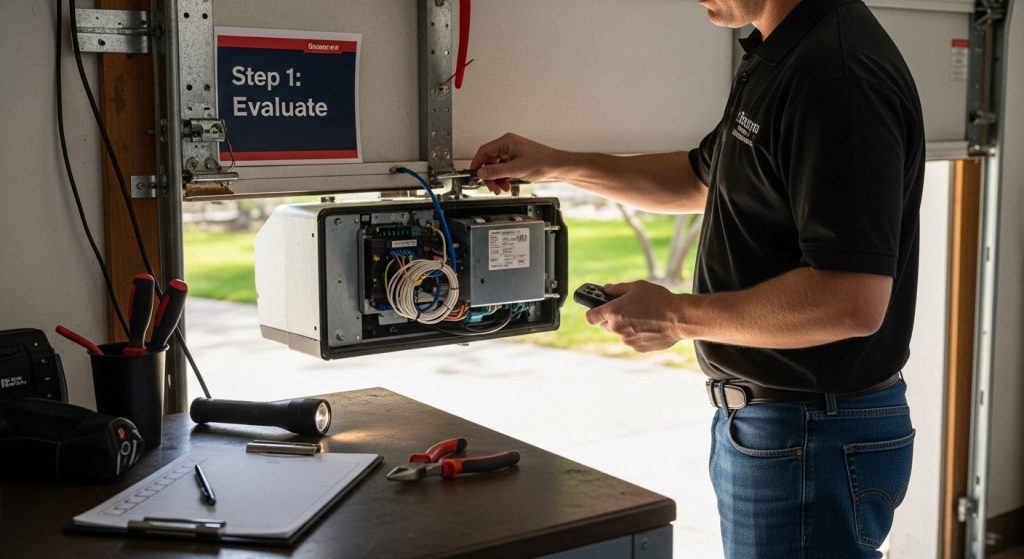
Homeowners often forget how easy it can be to break into a garage just by exploiting outdated openers. Believe it or not, older garage door openers built before 2015 usually lack modern security features, leaving homes much more vulnerable than most people realize. Upgrading your garage opener is not just about convenience, it could be the difference between a secure house and a break-in waiting to happen.
Table of Contents
- Step 1: Evaluate Your Current Garage Door Opener Setup
- Step 2: Update Your Opener’s Access Codes And Remote Settings
- Step 3: Install Security Features And Upgrades
- Step 4: Test Your Garage Door Opener Security Measures
- Step 5: Maintain And Regularly Check Security Protocols
Quick Summary
| Key Point | Explanation |
|---|---|
| 1. Evaluate existing opener vulnerabilities | Assess your garage door opener’s age and security features to identify risks. Older systems may lack modern safeguards. |
| 2. Update access codes regularly | Reset factory default codes with unique, strong combinations to enhance security against unauthorized access. |
| 3. Install advanced security features | Use motion-activated lighting and smart openers with rolling code technology for better protection and monitoring. |
| 4. Test all security measures regularly | Conduct comprehensive tests on remotes, firmware, and physical locks to ensure all systems are functioning correctly and securing your garage. |
| 5. Maintain security protocols consistently | Schedule quarterly reviews and updates of security settings, firmware, and connected devices to stay ahead of potential vulnerabilities. |
Step 1: Evaluate Your Current Garage Door Opener Setup
Securing your garage door opener begins with a comprehensive assessment of your current system. Understanding the vulnerabilities and potential risks in your existing setup is crucial for developing an effective security strategy. Most homeowners underestimate how their garage door opener can become an entry point for potential intruders, making this initial evaluation a critical first step.
Start by physically examining your garage door opener and its associated components. Locate the model number, typically found on the motor unit or inside the opener’s housing. This information will help you determine the age and technological capabilities of your system. Older models manufactured before 2015 often lack modern security features and might be more susceptible to unauthorized access.
Check the remote control mechanisms carefully. Fixed code systems are particularly vulnerable, as they transmit a consistent signal that tech-savvy criminals can potentially intercept and replicate. Modern garage door openers use rolling code technology, which changes the access code after each use, significantly reducing the risk of signal interception. If your current system uses older fixed code technology, it’s time to consider an upgrade.
Networked or smart garage door openers require additional scrutiny. Verify the firmware version and check whether the manufacturer provides regular security updates. According to NIST’s Consumer IoT Core Baseline, consumers should expect features like unique device identification, secure configuration options, and the ability to update software securely.
Verification checklist for your current garage door opener setup:
- Model manufactured after 2015
- Uses rolling code technology
- Firmware is current and updatable
- No known security vulnerabilities
If you want more detailed guidance on modernizing your garage door opener, check out our comprehensive installation guide for Seattle homeowners. By methodically evaluating your current system, you’re taking the first crucial step toward robust garage door opener security in 2025.
Below is a checklist table to help you verify that your garage door opener system uses up-to-date security features and is configured to minimize vulnerabilities.
| Verification Step | Description | Complete? |
|---|---|---|
| Model manufactured after 2015 | Confirm the opener was produced since 2015 for modern security features | |
| Uses rolling code technology | Ensures access codes change with each use, reducing interception risks | |
| Firmware is current and updatable | Current firmware receives security patches and updates | |
| No known security vulnerabilities | Verify with manufacturer or trusted sources for active security risks |
Step 2: Update Your Opener’s Access Codes and Remote Settings
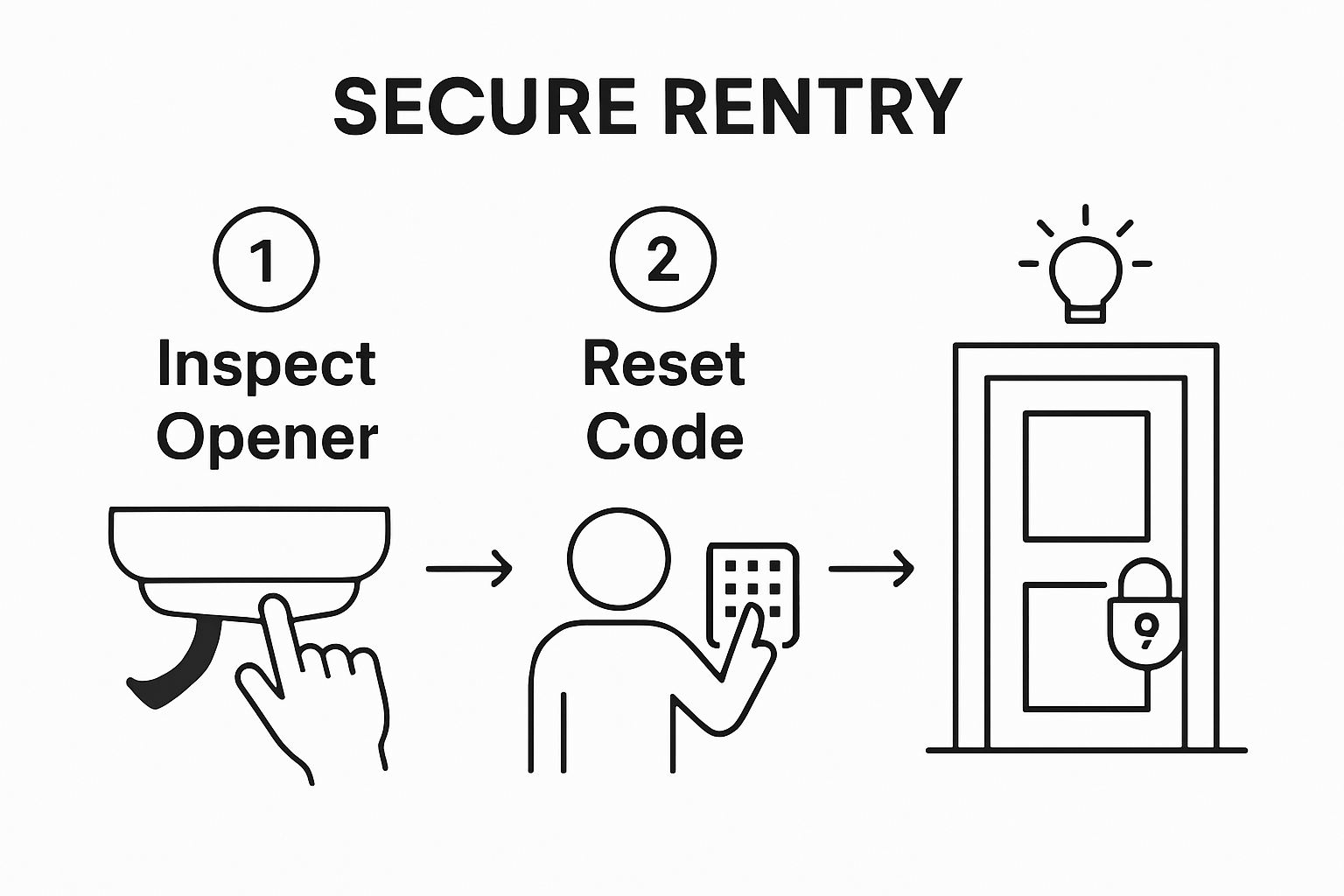
Updating your garage door opener’s access codes and remote settings is a critical defense against potential security breaches. Criminals often exploit default or unchanged credentials, making this step fundamental to protecting your home. The process involves systematically replacing factory settings with unique, strong authentication methods that minimize unauthorized access risks.
Begin by locating your garage door opener’s control panel or programming interface. Most modern systems have a dedicated button or sequence for resetting codes. Avoid using simple or predictable combinations like birthdays, sequential numbers, or repeating digits. Instead, create a complex code that combines random numbers and potentially includes a mix of uppercase and lowercase letters if your system allows alphanumeric entries.
For remote controls, synchronize and reprogram each device individually. This means thoroughly clearing existing codes from the system and reprogramming each remote with a unique identifier. Pay special attention to any additional remotes like those kept in vehicles or shared with family members. Limit the number of active remotes to only those absolutely necessary, reducing potential entry points for unauthorized access.
Smart garage door openers require additional configuration. Review your system’s cloud and mobile app settings, ensuring two-factor authentication is enabled and unnecessary remote access permissions are disabled. According to NIST’s Consumer IoT Core Baseline, consumers should implement secure, changeable configurations that prevent default credential usage.
Verification checklist for updated access codes and remote settings:
- All remotes individually reprogrammed
- Unique, complex access codes established
- Unnecessary remote access permissions removed
- Two-factor authentication activated
- Cloud/mobile app settings reviewed
If you need more detailed guidance on managing your garage door opener’s digital settings, explore our comprehensive remote programming guide tailored for Seattle homeowners. By meticulously updating your access codes and remote settings, you significantly reduce the risk of unauthorized garage door access.
Step 3: Install Security Features and Upgrades
Installing advanced security features transforms your garage door opener from a potential vulnerability into a robust protective system. This step goes beyond basic configurations, integrating technological safeguards that create multiple layers of defense against potential intrusions. The goal is to implement smart technologies and physical barriers that dramatically reduce unauthorized access risks.
Motion-activated lighting serves as an excellent first line of defense. Install bright LED sensors around your garage entrance that illuminate any movement, instantly deterring potential intruders and creating visibility during nighttime hours. Modern motion sensors can connect directly to smartphone apps, sending real-time alerts whenever unexpected activity is detected near your garage area.
Consider upgrading to a smart garage door opener with advanced encryption and rolling code technology. These systems generate a new access code with every single use, making signal interception virtually impossible for would-be criminals. Look for models that offer smartphone integration with two-factor authentication, allowing you to monitor and control garage access remotely while maintaining stringent security protocols.
Physical security upgrades complement technological solutions. Install additional manual locks on garage doors, preferably deadbolt styles designed specifically for garage applications. These provide a mechanical backup should electronic systems fail or experience temporary malfunctions. Reinforced door hinges and strike plates further complicate potential forced entry attempts, creating additional physical resistance points.
Verification checklist for security feature installation:
- Motion-activated exterior lighting installed
- Smart opener with rolling code technology configured
- Additional manual locks implemented
- Smartphone monitoring/alert system activated
- Physical door reinforcement completed
If you want comprehensive guidance on selecting and installing the most effective garage door security upgrades, explore our detailed installation recommendations tailored for Seattle homeowners. According to NIST’s Consumer IoT Core Baseline, implementing these security features represents a proactive approach to protecting your home’s most vulnerable entry point.
Step 4: Test Your Garage Door Opener Security Measures
Testing your garage door opener’s security measures is the critical final step in ensuring comprehensive protection for your home. This comprehensive verification process goes beyond simple functionality, proactively identifying potential vulnerabilities and confirming that every security enhancement you’ve implemented works precisely as intended.
Start with a comprehensive remote control test, systematically checking each programmed device’s range and functionality. Park at different distances from your garage, testing the remote’s responsiveness while ensuring no unintended signals are being transmitted. Pay close attention to signal strength and verify that only your specific remotes can activate the door. Random strangers walking or driving by should not be able to accidentally trigger your garage door opener.
Next, conduct a detailed smartphone app and mobile access verification. If your system includes cloud connectivity, attempt logging in from different devices and locations. Confirm that two-factor authentication functions correctly and that any unauthorized login attempts are immediately blocked. Test alert systems by intentionally triggering motion sensors or attempting incorrect access codes to ensure real-time notifications are working effectively.
Physical security testing is equally important. Deliberately attempt to manipulate the garage door manually, checking the effectiveness of additional locks and reinforcements you’ve installed. Simulate potential breach scenarios by testing the door’s resistance to external pressure. Verify that motion-activated lighting responds quickly and illuminates the entire garage entrance area when unexpected movement is detected.
Verification checklist for security measure testing:
- All remotes tested at various distances
- Smartphone app login security confirmed
- Motion sensors and alert systems verified
- Physical door reinforcements tested
- Lighting and detection systems validated
For homeowners seeking more detailed testing protocols, explore our comprehensive garage door security guide tailored for Seattle residents. According to NIST’s Consumer IoT Core Baseline, thorough testing is fundamental to maintaining robust cybersecurity for connected home devices. By meticulously verifying each security measure, you transform your garage from a potential vulnerability into a fortified entry point.
Step 5: Maintain and Regularly Check Security Protocols
Maintaining and regularly checking security protocols is the ongoing commitment that transforms your initial garage door opener security setup into a long-term protective strategy. This critical step ensures that your security measures remain current, responsive, and effective against evolving technological threats.
Create a quarterly security maintenance calendar to systematically review and update your garage door opener’s settings and configurations. Mark specific dates for comprehensive system checks, firmware updates, and credential reviews. During these scheduled maintenance windows, thoroughly examine every aspect of your garage door’s digital and physical security infrastructure. This proactive approach prevents potential vulnerabilities from developing unnoticed over time.
Technology evolves rapidly, making manufacturer firmware updates a crucial component of ongoing security. Enable automatic updates whenever possible, but also manually check for firmware releases every three months. Some smart garage door openers require manual intervention to download and install the latest security patches. Pay special attention to notifications from manufacturers about potential security vulnerabilities or recommended system upgrades.
Network security plays an equally important role in maintaining your garage door opener’s protection. Regularly audit the devices connected to your home network, removing any unauthorized or unfamiliar connections. Change your wifi password annually and ensure your router’s firmware remains current. Consider creating a separate network segment or guest network for smart home devices, further isolating potential entry points for cybercriminals.
Verification checklist for ongoing security maintenance:
- Quarterly system security review completed
- Firmware updates checked and installed
- Network device connections audited
- Wifi password updated
- Security alert notifications configured
If you need more detailed guidance on maintaining your garage door security systems, explore our comprehensive remote management guide designed for Seattle homeowners. According to NIST’s Consumer IoT Core Baseline, continuous monitoring and maintenance are fundamental to preserving the integrity of connected home devices. By treating your garage door opener’s security as an ongoing process, you create a dynamic defense against potential intrusions.
This table summarizes key ongoing maintenance tasks for garage door opener security, making it easy to schedule and track your regular updates and checks.
| Maintenance Task | Frequency | Purpose |
|---|---|---|
| System security review | Quarterly | Assess all security features and detect new vulnerabilities |
| Firmware updates | Quarterly/manual | Install latest security patches for smart and connected openers |
| Network device audit | Quarterly | Remove unauthorized devices and secure home network connections |
| Wifi password update | Annually | Refresh network access and prevent old compromises |
| Security alert configuration | As needed | Ensure notifications are set up for all suspicious activities |
Ready to Take Control of Your Garage Door Security in Seattle?
Feeling unsure about whether your garage door opener is really keeping your home safe? After reading about all the risks of outdated technology, weak access codes, and missing upgrades, it is easy to worry about vulnerabilities you may not have noticed. You deserve peace of mind knowing that your garage door is protected with the latest in smart technology, from rolling codes to reinforced hardware.
Summit Garage Doors can help you put those worries behind you. Our Seattle-based team is dedicated to making sure your garage door opener is secure, updated, and built for today’s challenges. If you are ready for a customized solution and expert support, visit Summit Garage Doors now. Explore our detailed guides for step-by-step help on garage door opener installation and remote programming. Trust our technicians to walk you through every upgrade and provide the confidence you need. Do not wait until a security gap becomes a real problem. Contact Summit Garage Doors today for protection designed especially for your home.
Frequently Asked Questions
How can I evaluate my current garage door opener security?
Start by examining the model number of your garage door opener, which can usually be found on the motor unit. Check if it was manufactured after 2015, as older models often lack modern security features. Also, verify if it uses rolling code technology instead of fixed code systems, and ensure that the firmware is current and regularly updated.
What steps should I take to update my garage door opener’s access codes?
Begin by locating your garage door opener’s control panel to reset the access codes. Create a unique and complex code that avoids simple patterns like birthdays. Reprogram all remote controls individually with unique identifiers, and if using a smart opener, enable two-factor authentication to secure access further.
What security features should I consider installing on my garage door opener?
Consider installing motion-activated lighting around your garage entrance to deter intruders. Upgrading to a smart garage door opener with rolling code technology can enhance security. Additionally, reinforce physical security with manual locks and door reinforcements to make forced entry more difficult.
How often should I maintain my garage door opener security?
Establish a quarterly maintenance schedule to review and update your garage door opener’s settings. During these checks, validate firmware updates, audit network security, and refresh access codes to ensure your garage door security remains effective against evolving threats.
Recommended
- Garage Door Code Requirements for Seattle and King County 2025 – Summit Garage Doors | Seattle’s #1 Garage Door Repair & Installation
- Top Residential Garage Door Trends for 2025 in Seattle – Summit Garage Doors | Seattle’s #1 Garage Door Repair & Installation
- How to Program Garage Remotes in Seattle for 2025 – Summit Garage Doors | Seattle’s #1 Garage Door Repair & Installation
- Garage Door Opener Installation in Seattle: 2025 Guide for Homeowners – Summit Garage Doors | Seattle’s #1 Garage Door Repair & Installation

