
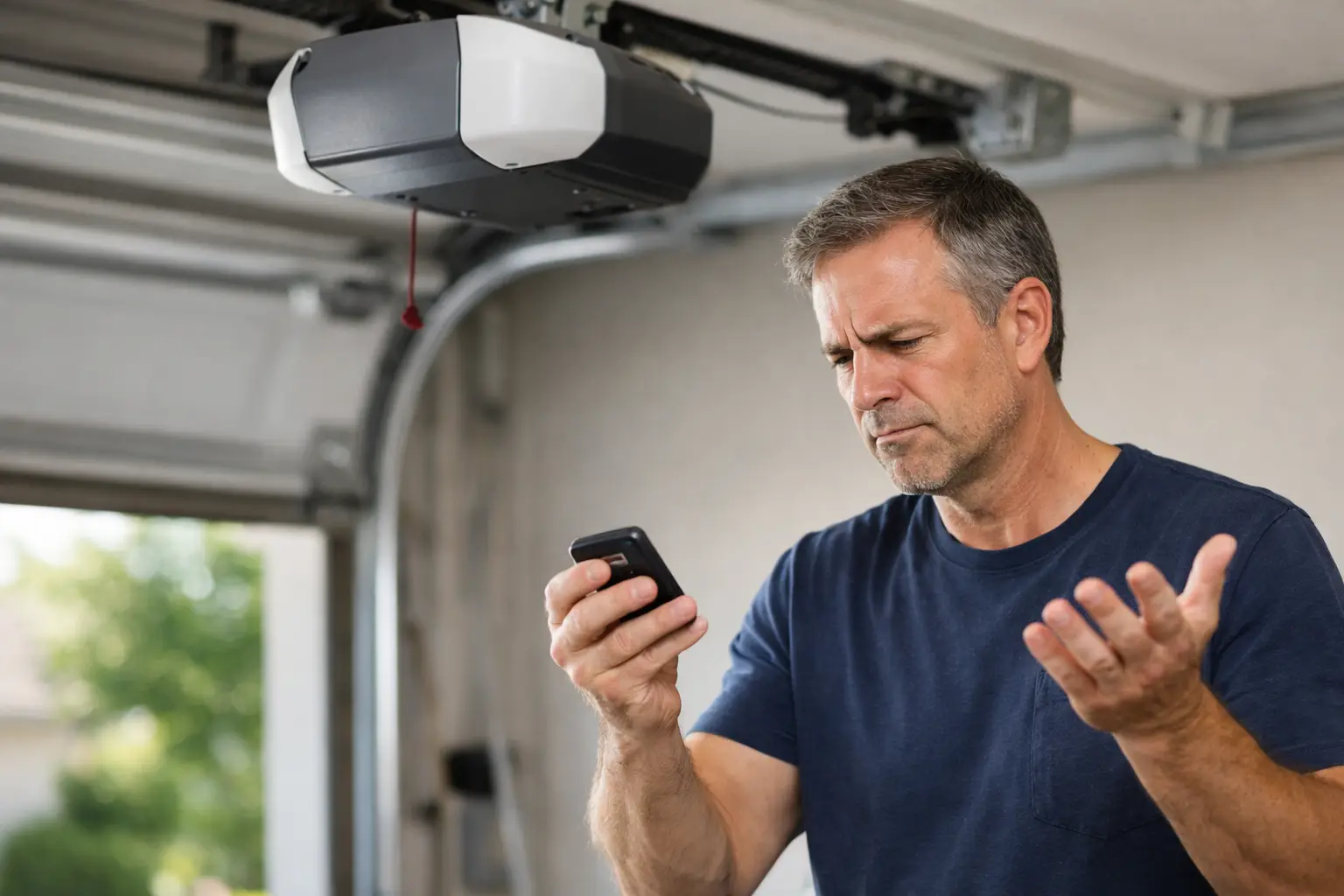
You press the wall button, hear a click, and nothing happens. Or the motor runs but the door stays put. Either way, a garage door opener failure can throw off your whole day, especially when your car is trapped inside or the door will not close securely.
When a garage door opener is not working, the issue is not always the opener itself. The problem could be as simple as a dead remote battery or as serious as a broken spring, damaged logic board, or door that is off track. Knowing the difference matters, because some fixes are safe to check yourself and some are not.
When your garage door opener is not working, start here
Before assuming the opener has failed, check the basics. If the wall switch works but the remote does not, the remote may need a new battery or reprogramming. If neither control works, the opener may have lost power, the circuit breaker may have tripped, or the internal motor unit may be failing.
Also look at the door itself. If the opener hums or strains but the door does not move, the issue may be with the springs, tracks, rollers, or trolley connection. Many property owners focus on the motor first, but the opener can only do its job if the rest of the system is working properly.
A quick visual check can save time. Make sure the opener is plugged in, the breaker is on, and the safety sensors near the floor are aligned and free of dirt. Those simple checks solve more service calls than most people expect.
Common reasons a garage door opener stops working
Power issues
This is the easiest place to start. An unplugged opener, a tripped GFCI outlet, or a breaker issue can make the system appear completely dead. If there are no lights on the opener unit and no response from the wall control, power is the first suspect.
That said, restored power does not always mean the problem is over. Some openers lose settings after an outage and may need to be reset or reprogrammed.
Dead remote batteries or remote signal problems
If the wall button works but the remote does not, the opener itself may be fine. Remote batteries wear out gradually, and signal interference can also cause inconsistent response. Nearby LED bulbs, new electronics, or even weather-related interference can affect range.
If one remote works and another does not, that points to the handset rather than the opener. If none of the remotes work but the wall control still does, reprogramming may solve it.
Misaligned safety sensors
Modern garage door openers rely on photo-eye sensors near the bottom of the door opening. If those sensors are blocked, dirty, bumped out of alignment, or have loose wiring, the opener may refuse to close the door.
This is one of the most common reasons a garage door opens normally but will not close unless you hold the wall button down. In many cases, gently cleaning the lenses and checking that both sensor lights are steady can restore normal operation.
Manual lock engaged
It sounds obvious, but it happens often. Some garage doors have a manual slide lock that can be accidentally engaged. If the opener tries to move a locked door, it may stop immediately or strain without opening.
If the lock is on, do not keep forcing the opener. That can damage the motor, trolley, or door sections.
Broken spring
A broken spring is one of the most serious reasons a garage door opener may seem not to work. The opener is designed to guide the door, not carry its full weight. If a torsion or extension spring breaks, the opener may lift the door only a few inches, reverse, or fail completely.
You may hear a loud bang when a spring snaps. You might also notice the door looks crooked, feels unusually heavy, or opens unevenly. This is not a DIY repair. Springs are under high tension and can cause serious injury.
Disconnected trolley
If the opener motor runs but the door does not move, the trolley may be disengaged. This often happens after someone pulls the emergency release cord during a power outage or while troubleshooting.
In some cases, reconnecting the trolley is simple. In others, it will not stay engaged because of wear or internal damage. If it keeps disconnecting, there is likely a larger issue with the opener or door balance.
Travel limit or force setting problems
Garage door openers have settings that control how far the door travels and how much force the motor uses. If these settings are off, the door may reverse before closing, stop short of the ground, or hit the floor and bounce back up.
Minor adjustments can solve the issue, but they need to be done carefully. If the door is already hard to move by hand, adjusting force settings without fixing the root cause can lead to more wear and tear.
Worn gears or failed motor components
Older openers often fail because of stripped gears, worn sprockets, or internal motor problems. You may hear the motor running without movement, or the unit may make grinding noises. At that point, repair versus replacement depends on the opener’s age, model, and condition.
If the opener is more than 10 to 15 years old, replacement is often the better long-term value, especially if you want quieter operation, battery backup, or smart controls.
What you can safely check yourself
If your garage door opener is not working, there are a few safe steps worth trying before booking service. Check power to the opener, replace the remote battery, clean the safety sensor lenses, and make sure nothing is blocking the door’s path. If the opener has a lock or vacation mode, confirm it has not been activated.
You can also test the door balance with caution, but only if the door is closed and there are no obvious signs of spring damage. Pull the emergency release and try lifting the door manually. It should move smoothly and not feel extremely heavy. If it slams shut, sticks, or feels difficult to lift, stop there and call a technician.
Do not attempt to repair springs, cables, or major opener components on your own. Those parts carry real risk, and guessing can turn a repair into a larger and more expensive problem.
When to call for professional garage door opener repair
Some issues are clear signs that professional service is the right move. If the opener has power but does not respond, if the door is stuck halfway, if the spring is broken, or if the opener is making unusual grinding or burning smells, it is time to stop troubleshooting.
The same goes for doors that are off track, sagging on one side, or reversing unpredictably. Those problems affect both safety and security. For homeowners and business owners, a door that will not close properly is not just inconvenient. It leaves the property exposed.
In the Seattle area, weather and moisture can also affect garage door systems over time. Corrosion, sensor issues, and worn electrical components are not unusual, especially on older units. A proper inspection helps determine whether the problem is isolated to the opener or tied to the full door system.
Repair or replace the opener?
It depends on the age of the opener, the cost of the repair, and what features you want. If the issue is a sensor alignment, wall control problem, or minor part replacement, repair is usually the sensible option. If the unit has repeated failures, lacks modern safety features, or struggles with daily use, replacement may save money over time.
New opener systems offer quieter performance, stronger security, Wi-Fi connectivity, and battery backup options. For households that use the garage as the main entry point, those upgrades are not just nice extras. They improve reliability and convenience every day.
A good technician should be honest about that trade-off. Not every opener needs to be replaced, but not every ageing unit is worth patching either.
Getting the right help fast
When a garage door opener stops working, speed matters, but so does proper diagnosis. Replacing a remote battery is one thing. Misidentifying a broken spring as an opener problem is another. The safest, most cost-effective approach is to figure out whether the issue is electrical, mechanical, or both.
That is why many local property owners turn to experienced service teams that handle the full system, not just the motor unit. If you need help identifying the cause, Summit Garage Doors can inspect the opener, door balance, springs, sensors, and hardware together so you get a fix that lasts.
A garage door should open smoothly, close securely, and work when you need it most. If yours is sending mixed signals, making new noises, or refusing to move at all, getting it checked sooner usually means a safer repair and fewer surprises later.

