
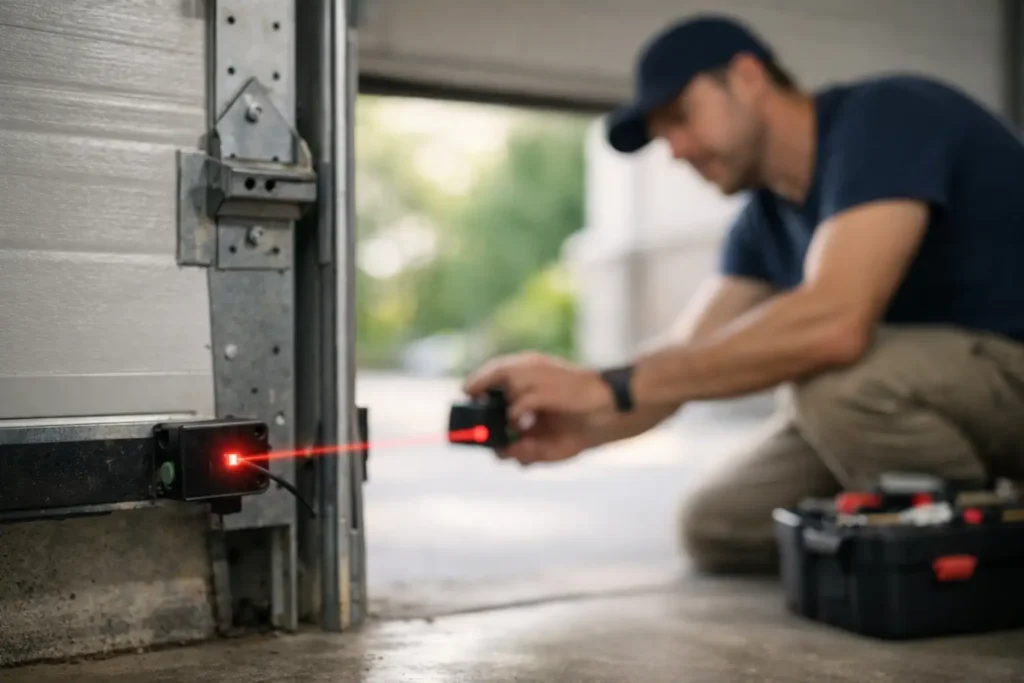
A garage door that starts down, flashes its opener lights, then reverses can turn a normal morning into a security and access problem. Garage door safety sensor issues are often behind this behaviour. The good news is that many sensor faults have a clear cause. The critical part is knowing which checks are safe to make yourself and when a door that will not close needs professional repair.
Safety sensors are there to prevent a heavy moving door from closing on a person, pet, vehicle, or object. They should never be treated as an inconvenience or bypassed to get the door shut. A quick inspection may restore normal operation, but a persistent problem deserves prompt attention.
How garage door safety sensors are meant to work
Most modern garage door openers use two photo-eye sensors mounted close to the floor, one on each side of the opening. One sensor sends an invisible beam across the doorway, and the other receives it. If that beam is blocked or the sensors cannot communicate, the opener should refuse to close the door fully or reverse it after starting down.
You will usually see a small LED on each sensor. The exact colours and meanings vary by manufacturer, but a steady light generally indicates a sensor has power and proper alignment. A blinking, dim, or unlit indicator often points to a blockage, misalignment, loose connection, or wiring problem.
This system protects people and property, but it also means ordinary conditions can trigger faults. A broom leaning in the doorway, a layer of dust on the lens, bright afternoon sunlight, or a sensor bracket bumped by a bike can be enough to interrupt the beam.
Common garage door safety sensor issues
The sensor lenses are blocked or dirty
Start with the simplest possibility. Look across the full width of the garage opening for boxes, garden tools, toys, leaves, snow, or anything sitting in the beam path. Remember that the sensors sit only a few inches above the floor, where small objects can be easy to miss.
If the opening is clear, gently wipe both lenses with a clean, soft cloth. Cobwebs, road dust, moisture, and grime can affect the signal. Avoid harsh cleaners or abrasive materials that may scratch the lens.
The sensors are out of alignment
Photo eyes need to face one another closely enough for the beam to connect. A sensor can shift after being kicked, struck by a bin, or loosened over time. You may notice one LED blinking while the other remains steady.
Check whether both sensors are mounted at a similar height and pointed directly across the opening. If a bracket is visibly loose, it may be possible to carefully reposition it and tighten the fastener. Do not force a bent bracket or pull on the wiring. A minor alignment issue is common, but recurring misalignment can mean the bracket, track area, or wiring needs repair.
Wiring is loose, damaged, or wet
The low-voltage wires running from the sensors to the opener can become loose at a terminal, nicked by stored items, chewed by rodents, or damaged by moisture. In older garages, ageing wire insulation can also become brittle.
A visual check is reasonable. Look for disconnected wires, obvious cuts, crushed sections, or corrosion near the sensors. Do not attempt electrical repairs if you are unsure of the opener wiring layout. Incorrect connections can keep the door from operating and may create a more complicated service call.
Sunlight is interfering with the beam
Low-angle sun can sometimes overwhelm a sensor receiver, especially in west-facing or east-facing garages at certain times of year. If the door works normally at night or on cloudy days but refuses to close in direct sun, light interference is a likely cause.
Cleaning the lenses and checking alignment may help. In some cases, a technician can adjust the sensor position, install appropriate shielding, or recommend a compatible sensor solution. Do not cover a sensor in a way that blocks its view of the opposite side.
The opener or door has a different problem
Not every closing problem is a safety sensor problem. A door that binds, shakes, makes grinding sounds, or reverses only after touching the floor may have a track, roller, spring, opener force-setting, or travel-limit issue. These repairs need a different diagnosis.
This distinction matters because repeatedly pressing the remote or changing opener settings without understanding the cause can make operation less safe. If the door is moving unevenly, hanging crooked, or feels unusually heavy when disconnected from the opener, stop using it and arrange service.
Safe checks to make before calling for repair
Before booking a repair, take a few minutes to rule out the most common causes. Keep people, pets, and vehicles clear of the doorway while testing the door.
First, remove anything near the sensor beam and clean both lenses. Next, look at the sensor LEDs and note whether either is off or flashing. Check that each sensor is secure, level with the other, and facing inward across the opening. Finally, inspect visible wiring for clear damage without tugging, splicing, or disconnecting anything.
After these checks, try closing the door with the wall control while watching it from a safe distance. Many openers will close while the wall button is held down when the photo eyes are not communicating. This is a manufacturer-designed temporary override, not a repair method. Never use it if you cannot see the entire doorway, and never leave the door operating unattended.
If the door closes only while you hold the wall button, the opener is strongly signalling a sensor-related fault. Do not rely on that override for daily use. The safety system still needs to be restored.
What not to do when sensors are failing
Avoid taping the sensors, tying wires together, disabling the opener, or trying to permanently defeat the safety feature. Those shortcuts expose people and property to a serious risk and may conflict with the opener manufacturer’s instructions.
Do not attempt to repair a broken spring, cable, or major track problem while investigating sensors. These components are under significant tension. A door can look like it has a sensor fault when the real issue is mechanical, and that is not a DIY repair.
It is also wise not to keep cycling the opener if it is straining, stopping unpredictably, or making a new loud noise. Repeated attempts can damage the opener gear or leave the door partly open when you need to secure the property.
When to arrange professional garage door service
Call for service when cleaning and careful realignment do not restore steady sensor lights, when wiring is visibly damaged, or when the door will not close safely without holding the wall control. Professional help is also the right choice if the sensors repeatedly go out of alignment or the opener is older and showing several symptoms at once.
For Seattle-area homeowners and businesses, weather exposure and busy garages can make small sensor problems more frequent. A technician can test the sensors, wiring, opener terminals, and door movement together. That complete assessment prevents paying for a sensor adjustment when the real cause is a failing opener board, damaged cable, worn rollers, or an unsafe door balance.
Summit Garage Doors can diagnose garage door safety sensor issues, replace faulty components when needed, and make sure the door closes smoothly without compromising its protective features. If the door is stuck open, will not secure, or is part of a commercial entrance, arranging prompt service can protect both daily access and the building.
Keep sensors reliable between service visits
A little preventative care can reduce surprise sensor faults. Keep the area near both photo eyes clear, especially if your garage stores sports gear, bins, or tools. Wipe the lenses during seasonal cleaning, and check that brackets have not been knocked loose.
When testing the door periodically, place a small object in the sensor path and confirm that the door will not close normally. Then remove the object and test again from a clear doorway. If the sensors do not respond as expected, stop using the automatic close function until the system has been checked.
Your garage door is one of the largest moving systems in your home or business. When its safety sensors send a warning, treating that warning seriously is one of the simplest ways to keep the entrance dependable, secure, and safe for everyone who uses it.

