
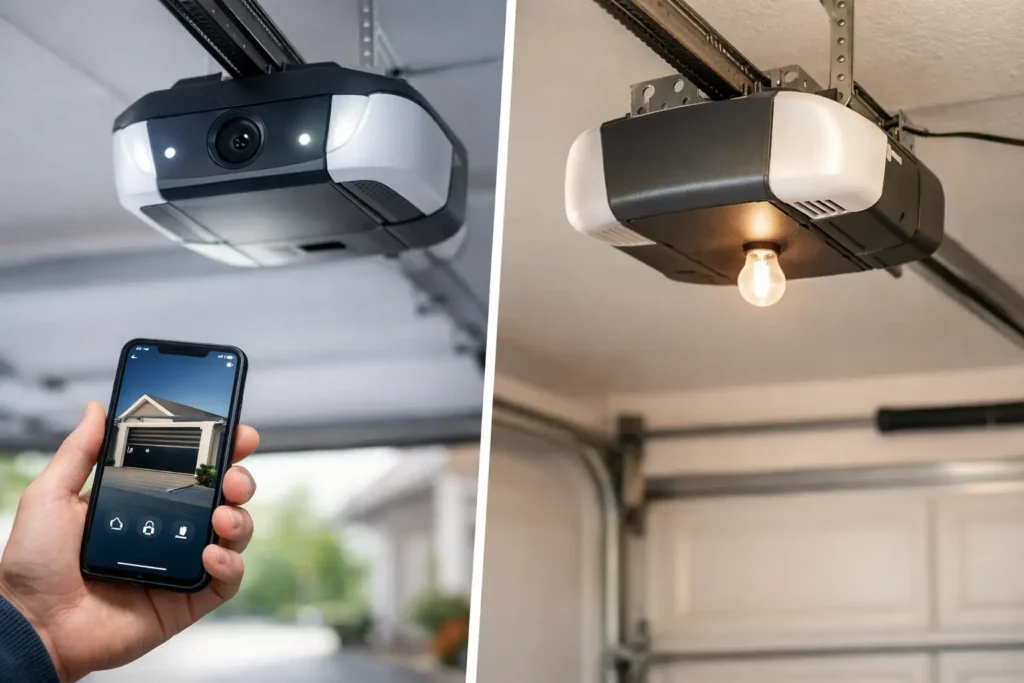
The difference between arriving home to a garage door that opens on command and wondering whether you remembered to close it is often one opener upgrade. In the smart opener vs standard opener decision, the best choice is not always the newest model. It is the model that matches how you use your garage, your security expectations, and the condition of the door it needs to operate.
For many Seattle-area homeowners, a dependable standard opener is all they need. For others, app control, activity alerts, and remote access solve daily frustrations that a traditional wall button cannot. Here is how to make a practical choice without paying for features you will not use.
What a Standard Garage Door Opener Does Well
A standard garage door opener uses a motor, rail system, remote controls, and a wall-mounted button to open and close the door. Most current models include essential safety features, including photo-eye sensors that stop or reverse the door if an object crosses its path. Many also use rolling-code technology, which changes the access code after each use to reduce the risk of remote-code copying.
Standard does not mean outdated or unsafe. A quality belt-drive or chain-drive unit can provide years of reliable service when it is correctly matched to the door’s weight and maintained properly. For homeowners who enter through the garage, use a physical remote, and do not need to monitor the door while away, this option is straightforward and cost-conscious.
The main advantage is simplicity. Fewer connected features can mean fewer setup steps, no dependence on a home Wi-Fi signal, and an easier learning curve for every member of the household. If the power goes out, the opener will still require its manual release unless it has a battery backup, but that is true of many smart models as well.
A standard opener may be the right fit if your garage routine is predictable, your vehicle remotes work reliably, and you simply want quiet, safe operation. It is also a sensible choice for rental properties, detached garages with weak Wi-Fi coverage, or commercial spaces where smartphone access is not appropriate for every user.
What Makes a Smart Opener Different?
A smart opener adds connected controls to the same basic garage door system. Through a mobile app, you can typically check whether the door is open or closed, operate it from a distance, receive alerts, and share access with family members or trusted visitors. Some systems also work with home automation platforms, cameras, delivery services, and voice assistants.
The most useful smart features tend to be practical rather than flashy. A door-left-open alert can prevent an overnight security concern. Remote operation can let a family member retrieve an item when you are away. Scheduled closing can help households where the morning rush regularly leaves the garage open.
Many smart systems allow you to create temporary access for a dog walker, contractor, or house guest instead of handing out a remote. You can revoke that access when the work is finished. Depending on the model and app settings, activity history can also show when the door was operated.
These features bring more responsibility. Your Wi-Fi network needs dependable coverage in the garage, the app must be set up correctly, and anyone given access should understand how to use it safely. Smart control is convenient, but it should never replace basic habits such as keeping the door in sight while it closes and making sure children do not play near the opening.
Smart Opener vs Standard Opener: The Real Comparisons
The right opener comes down to more than whether you can use a phone instead of a remote. Consider the daily trade-offs in convenience, security, cost, and long-term service.
Convenience and access
A standard opener is quick and familiar. Press the visor remote or wall button, and the door moves. There is no app to open and no notification settings to manage.
A smart opener is better for households with changing schedules, multiple drivers, frequent visitors, or a garage that is used as a main entrance. Remote monitoring is especially valuable when you are at work or travelling and cannot remember whether the door was closed. That said, an app is not necessarily faster than a remote when you are sitting in the driveway. Smart control adds options rather than replacing the simple controls people use every day.
Security
Both opener types can be secure when installed correctly. Modern standard openers with rolling codes offer much stronger protection than older fixed-code units. A smart opener adds awareness: alerts, status checks, access controls, and in some cases camera integration.
However, connected access requires good digital housekeeping. Use a strong, unique password for the app account, enable multi-factor authentication if available, keep the app updated, and remove access when a tenant, employee, or service provider no longer needs it. Smart features help most when they are managed with the same care as any other home security system.
Cost and value
Standard openers generally have a lower upfront cost, especially when comparing similarly powered units with the same drive type. Smart openers or smart-control add-ons can cost more, and certain features may require compatible equipment or optional subscriptions.
The better value depends on use. If remote monitoring prevents one stressful trip back home or makes access easier for a busy household, the added cost may feel worthwhile. If the garage is rarely used and a conventional remote does the job, paying extra for connectivity may not add meaningful value.
Reliability and service needs
The motor and drive system matter more to daily reliability than the smart label on the box. A quiet belt-drive opener is often a good choice for an attached garage beneath bedrooms. Chain-drive models are durable and economical, though they are usually louder. For heavy wood doors, insulated doors, or commercial applications, correct horsepower and door balance are critical.
A smart opener can still work as a normal opener when the internet is unavailable, provided you use the wall control or remote. What you lose during an outage is the ability to monitor and operate it from the app. A standard model avoids that dependency entirely.
Neither type can compensate for a door with worn rollers, bent tracks, failing cables, or broken springs. An opener should guide a properly balanced door, not force a heavy or damaged one through its travel. If the door is jerking, grinding, reversing unexpectedly, or straining to lift, have the mechanical issue assessed before replacing the opener.
Features Worth Prioritizing Either Way
Whether you choose a connected model or a conventional one, a few features deserve attention. Battery backup is particularly useful during power outages, allowing the opener to operate for a limited time when you need to get a vehicle out. Motion-activated lighting can make an attached garage safer and more useful. A quiet belt drive can reduce noise transfer into the home.
Safety sensors are non-negotiable, and they need occasional attention. Dust, spider webs, bumped brackets, or misalignment can cause the door to reverse or refuse to close. Test the reversing system periodically according to the manufacturer’s instructions, and keep the sensor path clear.
For business owners, access management and duty cycle deserve extra consideration. A residential smart opener is not automatically suitable for a busy commercial door. Frequent operation, door size, security requirements, and staff access all affect the right recommendation.
When an Upgrade Makes Sense
An upgrade is worth considering when an older opener is unreliable, excessively loud, lacks modern safety features, or no longer suits your household routine. It can also make sense when you are replacing a garage door. Installing a correctly sized opener at the same time helps ensure smoother operation from day one.
If your existing opener works well, a compatible smart controller may offer app-based convenience without replacing the entire unit. Compatibility matters, though. Older systems, damaged wiring, weak Wi-Fi signals, and unusual control setups may limit what an add-on can do.
Before choosing, think about the problem you are trying to solve. If you want quiet operation, focus on the drive type. If you need peace of mind when away from home, smart monitoring may be the priority. If your door is heavy or unreliable, start with an inspection of the door, springs, tracks, and balance.
A garage door should feel dependable every time you leave or return home. Summit Garage Doors can help homeowners compare opener options, assess the condition of the full door system, and install the solution that makes sense for how the garage is actually used. A clear recommendation starts with a door that operates safely, smoothly, and without unnecessary strain.

