
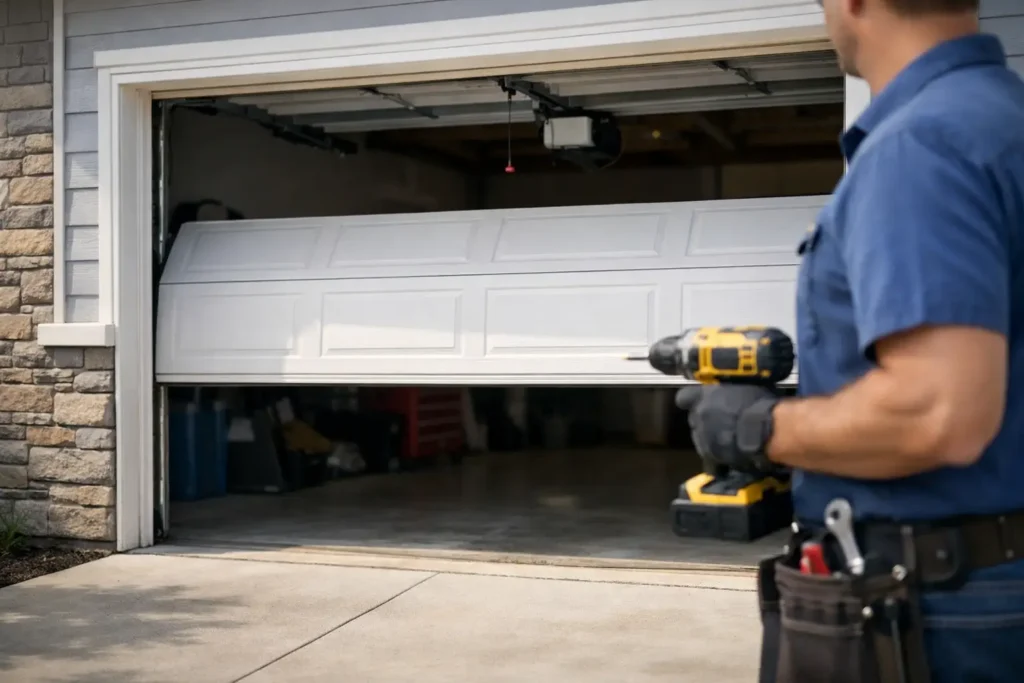
A garage door that rises only halfway and then stops can turn a normal morning into a security and safety problem. If you are asking why garage door opens halfway, the answer is usually not that the door has simply become stubborn. It is often a sign that the opener, springs, tracks, or safety system needs attention.
The right response depends on what the door does next. Does it reverse? Hang unevenly? Make a grinding sound? Stay stuck at the same point every time? Those details help identify the cause. What matters most is avoiding a forced repair, especially when springs or cables may be involved.
Why a Garage Door Opens Halfway
A sectional garage door is a balanced system. The opener provides movement, but the springs carry much of the door’s weight. Tracks guide the rollers, cables keep the lift even, and safety controls tell the opener when to stop. When one part is out of adjustment or damaged, the door may stop halfway because it cannot move safely or because the opener senses too much resistance.
In Seattle and surrounding King County communities, damp conditions can also expose issues that have been developing slowly. Rust on hardware, debris in tracks, and worn rollers can make a door drag more than usual. However, weather is rarely the only cause. A halfway-opening door deserves a closer inspection before the problem becomes a full failure.
Broken or Weak Garage Door Springs
Broken springs are one of the most common reasons a garage door will not open all the way. Torsion or extension springs counterbalance the door’s weight. When a spring breaks, the opener may lift the door a few feet, struggle, and stop. On some doors, it may open partway and then reverse.
A loud bang from the garage is a common sign of a broken torsion spring. You may also notice a visible gap in the spring above the door, although not every spring problem is easy to see. If the door feels unusually heavy when disconnected from the opener, spring failure is likely.
Do not attempt to replace or adjust garage door springs yourself. They are under extreme tension and can cause serious injury or damage when handled without the right tools and training. Keep the door closed if possible and arrange professional service.
Misaligned, Bent, or Blocked Tracks
Your door’s rollers need clean, straight tracks to travel smoothly. A small dent, loose mounting bracket, accumulated debris, or shifted vertical track can create enough friction to stop the door midway. The problem may be more noticeable at one particular height because that is where the roller catches.
Look for obvious leaves, dirt, small objects, or loose hardware along the tracks. You can safely clear loose debris with the door closed and inspect from a distance. Avoid using a hammer to straighten a track or loosening track brackets. Tracks are positioned precisely, and an incorrect adjustment can pull the door out of alignment or cause it to bind more severely.
If the door is crooked, one side is higher than the other, or a roller has left the track, stop operating it. Continuing to run the opener can bend components further and may damage the door panels.
Damaged Cables or Drums
Lift cables work with the springs to raise the door evenly. A frayed cable, slipped cable, or cable that has come off its drum can make one side of the door lift while the other side lags behind. The door may jam halfway, hang at an angle, or make a scraping sound.
Cable issues often occur after a spring breaks, but they can also result from worn parts, impact damage, or an obstruction under the door. This is another repair that should be left to a qualified technician. Cables can be under tension even when the door appears stationary.
Opener Travel Limits Are Set Incorrectly
If the door moves smoothly but stops at roughly the same halfway point without looking crooked or strained, the opener’s travel limit may be set incorrectly. Travel limits tell the motor how far to run during opening and closing. An accidental adjustment, power interruption, or previous service can sometimes affect those settings.
Modern openers use adjustment screws, dials, buttons, or digital controls depending on the model. The owner’s manual can help you identify the correct procedure for a basic limit reset. Make small changes only, then test the door from a safe distance.
There is a trade-off here: a simple limit setting issue can be corrected quickly, but changing settings will not solve a mechanical problem. If the door is heavy, noisy, jerky, or visibly binding, do not keep increasing the opener’s travel setting. The motor may be stopping because the door needs repair.
Obstructions and Safety Sensor Problems
Safety sensors are usually associated with a door that will not close, but an obstruction or damaged component can affect overall operation. Check the area around the door for stored items, ice, packed debris, or anything that could interfere with the bottom section as it moves.
Also inspect the photo-eye sensors near the floor. Make sure their lenses are clean and that the indicator lights are on as expected. Misaligned sensors generally prevent closing rather than opening, but checking them is worthwhile when your door’s behaviour has changed after being bumped or after garage cleanup.
Worn Rollers, Hinges, or Bearings
Garage doors have many moving parts, and gradual wear can create a halfway stopping issue long before a part breaks completely. Worn rollers can drag in the tracks. Dry hinges can bind as panels bend through the curve of the track. A failing bearing plate may add resistance near the top of the opening cycle.
Listen for squealing, grinding, popping, or repetitive clicking. These sounds do not always mean an emergency, but they do mean the system is working harder than it should. Timely maintenance can often replace worn parts before they damage the opener or cause the door to get stuck at an inconvenient time.
Safe Checks to Make Before Calling for Repair
Start by keeping people, vehicles, and pets clear of the doorway. Do not stand beneath a door that is stuck open or partially open. If it is safe to do so, use the wall button to close the door and avoid repeated attempts to open it.
With the door fully closed, you can check for visible obstructions in the tracks, damaged panels, loose rollers, and obvious spring gaps. You can also confirm that the opener has power and that the remote battery is working. If the opener hums but the door does not move, or if the door moves unevenly, stop testing it.
Only disengage the emergency release when the door is fully closed, unless a professional has instructed you otherwise. Pulling the release on a partially open door with a broken spring can allow the door to fall quickly. A door that weighs several hundred pounds is not safe to catch by hand.
When a Halfway-Opening Door Needs Urgent Service
Some garage door problems can wait for a scheduled visit. Others should be treated as urgent because they affect security, access, or physical safety. Request prompt professional help if you see a broken spring, loose or frayed cable, off-track roller, bent track, or a door hanging unevenly.
You should also call for service if the garage door is your only practical way to access a vehicle, if it cannot close securely overnight, or if the opener is straining and overheating. Continuing to operate a door with a mechanical fault can turn a targeted repair into a larger replacement job.
A trained technician can test the door balance, inspect spring tension, check cables and drums, align tracks, assess roller wear, and confirm whether the opener is operating correctly. Summit Garage Doors provides practical recommendations based on the actual condition of the system, whether the solution is an adjustment, a replacement part, or a more complete repair.
Preventing the Problem From Returning
A garage door should open smoothly, stay balanced, and operate without excessive noise. Annual professional maintenance is a sensible investment for most residential doors, while high-use commercial doors may need service more often. Regular inspections catch loose fasteners, worn rollers, weakening springs, and opener issues before the door begins stopping halfway.
Between visits, keep tracks clear, avoid hitting the door with vehicles or equipment, and pay attention when the sound of operation changes. Do not apply random lubricants to every part of the system. The wrong product can collect grime in tracks or interfere with components that need a specific lubricant.
A halfway-opening garage door is rarely a problem to ignore. Treat the door’s behaviour as useful information: smooth movement may point to an opener adjustment, while strain, noise, or uneven lifting usually signals a mechanical repair. Acting early protects your door, your vehicle access, and the people using the space every day.

