
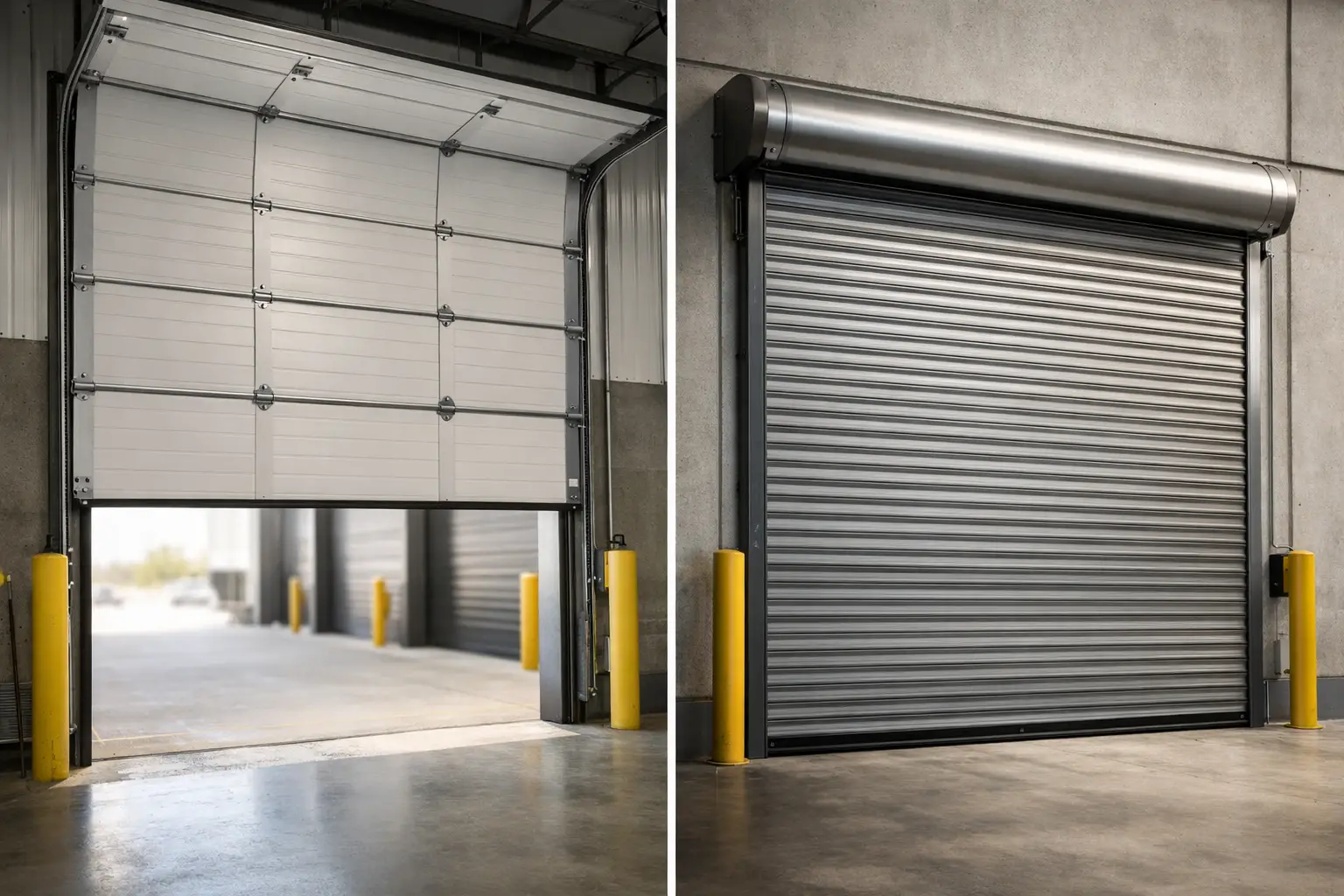
If you are weighing sectional versus roll up doors, the wrong choice usually shows up later – in noise, repairs, wasted space, or a door that does not suit how you actually use the building. On paper, both options open vertically and help save driveway space. In real use, they behave very differently.
For homeowners and business owners, that difference matters. A door is not just a panel that goes up and down. It affects security, daily convenience, weather protection, maintenance needs, and how much value you get from the installation. The better fit depends on your opening size, ceiling clearance, traffic level, insulation needs, and budget.
Sectional versus roll up doors: the core difference
A sectional door is made of large horizontal panels hinged together. As the door opens, those sections travel on tracks and rest overhead, parallel with the ceiling. This is the style most people picture when they think of a standard residential garage door.
A roll up door, sometimes called a coiling door, is built from many narrow steel slats. Instead of sliding back along overhead tracks, the curtain coils into a compact roll above the opening. You will see this style more often on commercial units, storage facilities, service bays, and industrial spaces.
That basic difference changes almost everything else. Sectional doors tend to offer more design flexibility, better insulation options, and a more finished look for homes. Roll up doors are often chosen for durability, compact operation, and simpler performance in tougher commercial settings.
Which door works better for residential properties?
For most homes, sectional doors are the more practical choice. They are available in a wide range of styles, colours, window layouts, and insulated construction options. If curb appeal matters, sectional doors give you far more control over the final look.
They also tend to operate more quietly when properly installed and maintained. That matters if the garage is attached to the house or sits below a bedroom. In many residential settings, a quieter door with better thermal performance is worth more over time than a purely utilitarian option.
Roll up doors can work on residential properties, but they are usually chosen for specific reasons rather than appearance. A homeowner may prefer one for a detached workshop, laneway structure, or a garage with limited interior space above the opening. If the priority is compact function over finish, a roll up door may make sense.
Still, for the average house, sectional doors usually win on appearance, insulation, and day-to-day comfort.
Sectional versus roll up doors for commercial use
Commercial properties often flip the equation. Roll up doors are popular because they are tough, compact, and well suited to high-use environments. In a warehouse, auto shop, loading area, or storage building, function usually comes first. A roll up door can handle repeated cycles and is often a strong fit where overhead space must stay as open as possible.
Sectional doors still have a place in commercial buildings, especially where insulation, appearance, or larger glazed sections are important. Service shops, fire stations, and commercial storefront bays often use sectional doors because they can be customized for visibility and energy performance.
The better choice depends on the building’s purpose. If you need a clean, insulated, customer-facing door, sectional may be the better investment. If you need a hardworking security door for frequent operation, roll up often has the edge.
Space and headroom matter more than most people expect
One of the biggest practical differences is how each door uses interior space. Sectional doors need overhead track space because the panels travel back into the garage. That is fine in many homes and standard commercial buildings, but it can be limiting in spaces with unusual framing, lighting conflicts, or storage needs near the ceiling.
Roll up doors store above the opening in a coil, which can reduce the need for long horizontal tracks. In some buildings, that makes layout much easier. You may gain more usable ceiling area and fewer obstructions inside the space.
That said, roll up doors still need room for the barrel assembly above the opening. So this is not a case where one system always fits and the other does not. The opening dimensions and surrounding structure need to be measured carefully before deciding.
Insulation and weather performance
In a climate with wet winters and cooler temperatures, insulation can quickly become a deciding factor. Sectional doors are generally stronger in this category. Many are available with insulated steel sandwich construction, weather seals, and higher thermal performance that helps keep garages more comfortable and energy loss more manageable.
This is especially relevant if the garage is attached to the home, used as a workspace, or sits near finished living space. Better insulation can also help reduce outside noise.
Roll up doors can be insulated, but many standard models are more basic and are chosen for security and function rather than energy efficiency. If your building needs strong thermal control, not every roll up option will meet that need without moving into a higher price range.
For customers in the Seattle area, where moisture control and dependable operation through changing weather are important, the build quality of the door and the seal around it matter just as much as the door style itself.
Maintenance, repairs, and long-term wear
No garage door is maintenance-free. The real question is what kind of wear you are likely to see and how easy it is to service.
Sectional doors have more exposed moving parts across the track system, including rollers, hinges, cables, and springs. When they are installed properly, they operate very well, but they do require periodic adjustment and maintenance. Damage to one panel may sometimes be repairable without replacing the whole door, which can be an advantage.
Roll up doors are often viewed as rugged and simple, especially in commercial settings. Their slatted design can perform well under frequent use, but repairs can become specialized depending on the curtain, guides, and tension system. If the door takes an impact or the coil mechanism is affected, the fix may not be as straightforward as some owners expect.
This is where honest recommendations matter. A door that looks cheaper upfront can cost more later if parts are hard to source, insulation is poor, or service becomes more involved.
Cost: upfront price versus long-term value
Price is one of the first questions customers ask, and the honest answer is that it depends on size, material, insulation, opener compatibility, and installation complexity.
Basic roll up doors can be cost-effective for simple commercial or utility applications. If appearance and insulation are not top priorities, they may offer a practical path to secure access.
Sectional doors often span a wider price range. A basic non-insulated model may be affordable, while a premium insulated carriage-style or full-view design can cost significantly more. For homeowners, though, that added cost often buys better aesthetics, quieter operation, and stronger resale appeal.
The best value is not always the lowest quote. It is the door that fits the building, performs reliably, and does not create avoidable service issues a year later.
Security and durability
Both door types can be secure when properly installed with quality hardware. Roll up doors are often chosen for commercial security because their steel slat construction and compact design can feel more industrial and resistant to hard use. They are a common fit for storage and service environments for a reason.
Sectional doors can also provide strong security, especially in steel construction with modern locking and opener systems. For residential properties, they usually offer more than enough protection when paired with good installation and regular maintenance.
Durability comes down to more than the door style. Cycle rating, material thickness, spring quality, track alignment, and local service support all matter. A well-installed door with the right components will usually outperform a poorly chosen door of any type.
How to choose the right fit
If you are choosing for a home, sectional is usually the safer bet unless you have a specific space constraint or utility use that points to roll up. If you are choosing for a commercial or industrial property, roll up may make more sense when durability, compact storage, and repeated use are the main concerns.
It also helps to think beyond the opening itself. Ask how often the door will be used, whether the space needs insulation, how visible the door is from the street, and how important quiet operation is. A detached storage building has different priorities than an attached garage or customer-facing commercial bay.
At Summit Garage Doors, this is the part where good advice saves customers money. The right recommendation is not about pushing one style over the other. It is about matching the door to the building, the daily workload, and the expectations you will have after installation.
A garage door should make the property easier to use, not harder to live with. If you are comparing options, the smart move is to choose the door that fits your space and your routine five years from now, not just the one that looks easiest today.

